
Performance Guide
Audience: package users who want to know where the speed comes from and where it stops. This page explains the data path that makes a call cheap, when a batch call pays, and how the optional cell ceiling keeps a large request from killing the process. Measured figures live in Benchmark report; this page explains the behaviour behind them.
Why native
Section titled “Why native”react-native-nitro-h3 vendors the H3 C library (v4.5.0) and calls it from C++ through Nitro
Modules. h3-js runs the same C library compiled to JavaScript with Emscripten, and every cell that
crosses into h3-js is a hexadecimal string.
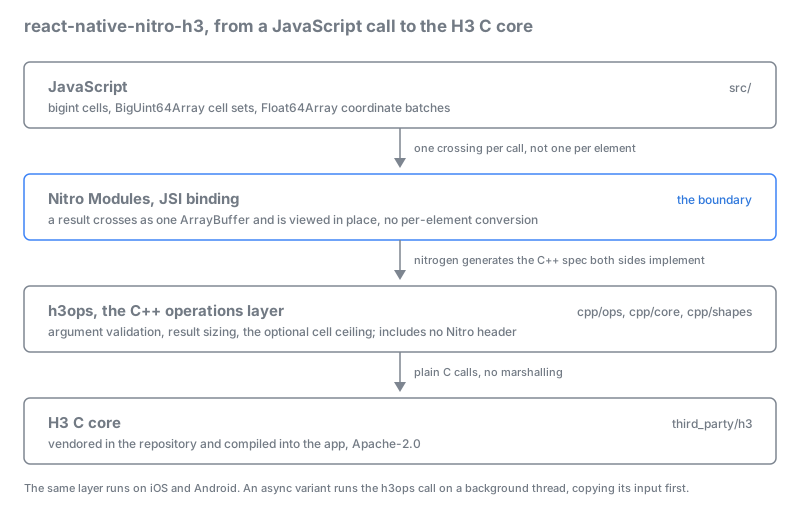
Three things are cheap on this path and expensive on the other:
- One crossing per call, not one per element. A
BigUint64Arrayresult is oneArrayBufferthat JavaScript views in place.h3-jsreturns astring[], one allocation per cell. - No string conversion. A cell is a 64-bit integer on both sides of the boundary.
h3-jsformats and parses a hexadecimal string per cell on the way in and out. - No marshalling below the boundary. The
h3opslayer validates arguments, sizes the result and applies the cell ceiling, then makes plain C calls into the vendored core.
The difference is largest where h3-js’s string handling dominates the work the call does:
compactCells on a k=20 disk of 1,261 cells is 862× faster on the iPhone XS (iOS 18.7.9, React
Native 0.87.0, Hermes, 20-run median, 2026-09-01). Where a call does little work per element, the
factor is smaller: latLngToCell over 100,000 calls is 24×. Both rows are in
Benchmark report.
When a Batch Call Pays
Section titled “When a Batch Call Pays”The batch rows in the benchmark run one native call against the JavaScript loop it replaces, over
100,000 elements. That size is favourable by construction. Below a few hundred, one crossing plus a
typed-array allocation is a larger share of the total, and that crossover is unmeasured. Building
the input Float64Array is not timed on either side either, so a caller who assembles one from
JavaScript objects pays for that on top. The measured rows are W11 and W12 in
benchmark.md.
The contract of all three calls is in Typed arrays and batch calls.
The Cell Ceiling in Detail
Section titled “The Cell Ceiling in Detail”There is no cell limit until you set one: a call returns whatever you ask for, exactly as h3-js
does. Sizes grow fast, and a cell costs 8 bytes in the returned BigUint64Array. A batch call that
answers coordinates weighs more per cell: cellsToBoundaries costs 161 bytes, so the same ceiling
admits about twenty times the memory there.
gridDisk(cell, k) returns 1 + 3k(k+1) cells, so k of 1,155 is 4,005,541 cells or 32 MB, and
polygonToCells over San Francisco at resolution 12 is 412,377.
A request keeps growing from there: gridDisk(cell, 4000) is 48,012,001 cells, 384 MB packed, and a
polygon covering a country at resolution 15 reports far more. On a mobile device an allocation at
that scale is not a slow call. It is a silent process kill that your JavaScript try/catch cannot
intercept. Set a cell ceiling and the request is refused before anything is allocated:
import { configure } from 'react-native-nitro-h3'
// 4,000,000 cells is exactly 32 MB at 8 bytes per cellconfigure({ maxCellCount: 4_000_000 })
Every cell-producing function then queries the required size first and throws a catchable H3Error
when the answer is over the ceiling:
The requested result of 4005541 cells exceeds the cell limit of 4000000 set with configure({ maxCellCount }). Raise or remove the limit to allow it.With a ceiling in force, polygonToCellsExperimental refuses an unaffordable polygon before its own
size query walks it, priced by the bounding-box estimate polygonToCells uses, or by the length of
the outline where that box has no area.
configure({ maxCellCount: Infinity }) removes a ceiling set earlier. The value must be a positive
integer or Infinity, and it applies to every sync and async cell-producing function from the
moment it is set.
How It Compares to h3-js
Section titled “How It Compares to h3-js”h3-js offers no equivalent setting; it only bounds its Emscripten heap at a massive 2 GB. A heavy
call there will just execute: gridDisk(cell, 1155) allocates all 4,005,541 cells,
measured on a desktop machine in benchmark.md.
The four async variants and what a thread hop costs are in
Sync and async; the H3Error contract and the ceiling from the
caller’s side are in Errors and memory safety.